Saturday, January 30, 2021

 Ryedown Lane - Locomotives and stock, part 2


In a previous blog we looked at the original locomotives that operated on Ryedown Lane when first built. These still see regular use to this day but, like most modellers, I can't resist the urge to expand the fleet.

Two other locomotives built from white metal kits, that had seen operation on my previous layout, were also suitable candidates for use on a Colonel Stephens inspired light railway. I've long been fascinated by the early diesel locomotives constructed by Kerr Stuart & Co. As is well known the prototype had a short stint in use on both the Welsh Highland and the Ffestiniog in 1928/29 and is currently the subject of a volunteer led restoration on the modern F&WHR. My original model of this locomotive was built from the popular Meridian Models kit and mounted, as per the instructions, on a modified Minitrix chassis. It's a distinctive locomotive but the second hand chassis has never been a great runner, or at lest not until it has warmed up! In more recent times it's been joined by another example built from the etched kit made by A1 Models running on one of the ubiquitous Bachman Plymouth diesel switchers chassis, the so-called 'brick'.
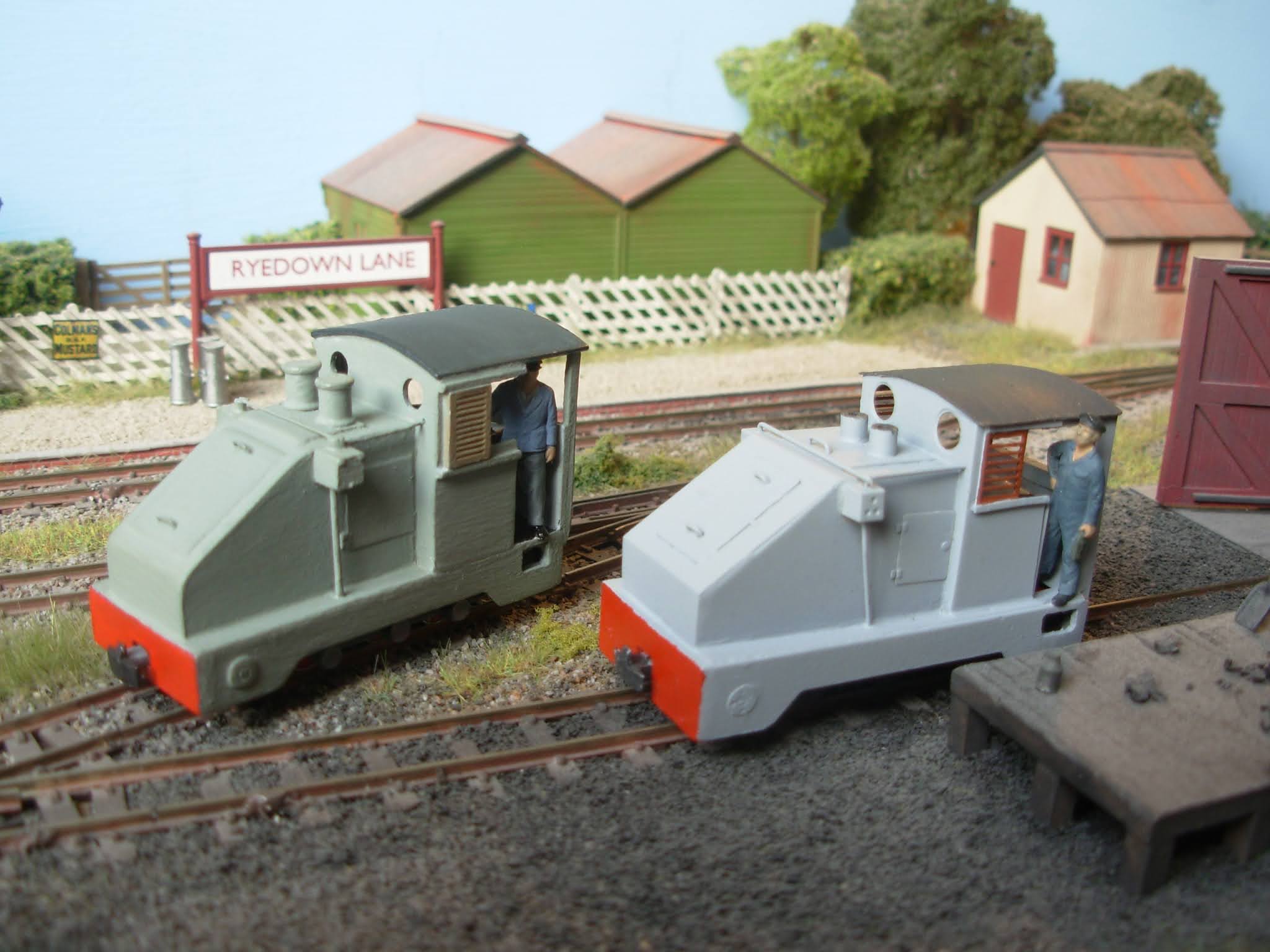
The Kerr Stuart diesels. Earlier Meridian white metal on the left with the later A1 Models example in etched brass on the right.


Also built from a Meridian kit is this Protected Simplex. Numerous examples of the former War Department Light Railways petrol tractors saw service in a variety of locations in peacetime, including the Ffestiniog. My example was originally powered by an Arnold Koff chassis but in recent years this has been replaced by one of the inexpensive units made by Tomix of Japan.

                                                                'Tin Turtle' Protected Simplex.

There are a number of alternatives to the 'traditional' white metal kit for modellers working in 009 narrow gauge these days, including etched brass, resin and 3D printed materials. Examples of all of these now appear in the Wessex Light Railway's stud and we will share the story of some of these in future blogs. It's not the end of the white metal kit though and plenty remain on the market. The most recent locomotive of such origins is 'Alfred', another Kerr Stuart Skylark built from the excellent Chivers/Five 79 kit. This time the assembled body was fitted to one of the superb Minitrains chassis, in this case the outside frame 0-4-0. 'Alfred' has become another mainstay of operations on the layout.

                             Kerr Stuart Skylark 'Alfred' about to leave Ryedown Lane with a passenger train.


Friday, January 8, 2021


Flashback Friday -The Class 33s

For Christmas I received a copy of Simon Lilley's excellent book 'The Class 33s - A Sixty year History' http://www.crecy.co.uk/the-class-33s Growing up on the Hampshire/Sussex border in the 1970s and 1980s Class 33s were a familiar sight. In fact, other than the Electro-Diesel Class 73s and the occasional visiting Class 47, they were for a long time the only locomotives that we saw among the constant procession of EMUs. It's been an enjoyable read and I've certainly found out a lot of things I didn't know about these familiar engines.

Looking at the well illustrated volume has been quite a nostalgic exercise, seeing many of my favorite individual class members and even reading about a few events at which I was present. In the mid 1980s I decided to try to photograph as many of the class as I could, only a handful having been withdrawn by that time. If memory serves, by the time of large scale withdrawals in the 1990s I'd photographed all but one or two of the 33/0s, all of the push-pull fitted 33/1s and was only short of two of the slim-Jim 33/2s.

Unfortunately, most of my photographic collection from the 1980s is not accessible to me in the current lockdown but I have had a sort through some images from the early 1990s including these two from late 1992:


A personal favourite was 33 008 'Eastleigh'. Named in 1980, in 1986 Eastleigh depot started a gradual process of restoring it's original and attractive green livery. This was retained until 1990 when it was repainted in the departmental grey/yellow 'Dutch' livery. Happily, Eastleigh were allowed to restore the green livery in 1992 and it is in this condition, with original D prefix numbers, that I saw it at Salisbury on 18th October that year.


A few weeks previously, on 13th September, I took this picture of 33 102 at Bournemouth Depot open day. This is far more typical of the way that I remember the class in day to day service.

Although cited for withdrawal in the 1990s, amazingly a few Cromptons soldiered on to work on the privatised railway network of the late 1990s. A small number are  still to be seen at work on mainline duties, including three with West Coast Railways.


Slim Jim 33 207 is seen at Yeovil Junction in July 2017 when involved with the working of the 'End of Southern Steam' railtour which it top 'n' tailed with 34046 Braunton. The Crompton worked the non-steam leg from Yeovil Junction to Weymouth via Yeovil Pen Mill. Hopefully it wasn't my last mainline run behind a Class 33.


Monday, January 4, 2021

 Workbench projects - ending the old year on a high.

Making the most of the time off work, the school holiday and the need to stay at home to comply with the Tier 4 restrictions, Christmas 2020 proved to be a quiet and enjoyable time in and around the house. With the children now at an age where they are able to entertain themselves, for some of the time at least, I was able to escape to the workbench for an hour or two on most days which enabled me to tinker with various projects that i have under way.


I spent some of the time trying to finish this standard gauge Hibberd Planet locomotive built from the excellent Planet Industrials kit designed by James Hilton. I bought it from the Narrow Planet stand at the 2019 Warley show (ahh, model railway exhibitons ... remember them?) but didn't get round to starting the build until the summer. In keeping with the designer's intentions, it's an easy kit to build combining 3D prints and etched panels running on a Tenshodo Spud chassis. The length of time taken to reach this 'nearly-finished stage' is wholly down to my own inability to stick to one thing at a time rather than any issues with the kit itself. The picture shows the almost completed model, which now just needs couplings, the addition of a driver figure and a little more weathering to complete. 

Check out the Planet Industrials website https://www.planetindustrials.co.uk/ to see their range of interesting products and to see their exciting plans for 2021 (I have no connection with Planet Industrials other than as a very satisfied customer and the occasional exchange of banter with the proprietors at exhibitions over the years). 

There are several other things on the bench at present as well, and slow progress is also being made with a permanent loft layout, but we'll finish here by wishing everyone a happy and healthy New Year and let's hope it's not too long before life returns to normal.


Monday, December 14, 2020


Ryedown Lane

 Locos and stock – Part 1, the first white metal kits


The locomotives and rolling stock that I use on Ryedown Lane has attracted some favourable comment at exhibitions and on the NGRM Online forum. At the risk of repeating a few facts already discussed on the forum, here is the first of a series looking at the stories behind some of the regulars to be seen on the layout, starting with locos built from white metal kits

Returning to railway modelling and getting into 009 narrow gauge in the early 2000s one had limited options when it came to providing locomotives and rolling stock. The only ready to run stock available was European HOe some of which could be adapted. Otherwise, the only route was kit building and kit bashing or, given the skills, scratch building. My first attempts at kit-built locomotives were a couple of Chivers diesel outline locomotives built on Graham Farish chassis. They went together well enough so I moved onto my first steam locomotive, the ubiquitous Peco Glyn Valley Beyer peacock tram locomotive also fitted on Farish 0-6-0 chassis. These locomotives initially saw use on my Wintonchester Water Works industrial micro layout, for which they were all a bit on the large size.

My interests were turning towards building a common carrier narrow gauge railway and at first, along the lines of a layout based on one of the proposed but never built extensions to the Snailbeach District Railway. I was familiar with the area and the theme fitted in with my interest in the various Colonel Stephens railways. Fortunately, kits were available for the locomotives and rolling stock.


First off was the Chivers kit for the Kerr Stuart ‘Skylark’ No. 2. Here I encountered a problem familiar to most 009 modellers. The kit had been introduced in the 1980s and was designed to fit a chassis that was no longer available. Fortunately around this time Neville Kent of N Drive Productions was just starting to sell his range of replacement RTR chassis. I acquired one of his short wheelbase 0-4-0s and fitted a pony truck adapted from the parts supplied in the excellent Chivers kit. It worked although the real SDR No.2 was outside frame and my version was inside frame (KS supplied Skylarks for use on a variety of gauges and inside framed versions did exist).


Famous among Snailbeach locomotives was the large Bagnall 0-6-0T ‘Dennis’, dismantled for overhaul on the Colonel's orders in the early 1920s and never rebuilt. GEM produced a kit for this to fit the Farish 0-6-0 chassis (again, an inaccurate inside framed locomotive is the result). A friend in Wessex Narrow Gauge Modellers had a part-built one which he no longer wanted and was willing to sell to me. With much of the assembly done, all I had to do was add some of the details, fit the motion to the chassis and paint. The resulting locomotive is a big beast indeed and has since become the pride of the line.

In the end, I gave up on the Snailbeach idea and the layout that I’d started became Ryedown Lane, the terminus of the Wessex Light Railway, a little-known narrow gauge addition to the Stephens empire. No 2 and ‘Dennis' (which was eventually renamed ‘Wessex’) became the main motive power in the layout’s early years.


Friday, December 4, 2020


Flashback Friday: The Royal Duchy, 3 April 2010, a railtour remembered


2020 has seen so many of the things that we normally take for granted denied us. Every walk of life has been affected in some way by the restrictions that have, of necessity, been imposed upon us. Those of us involved in any of the many facets of the railway hobby will be all too familiar with the things that we haven’t been able to do, from club evenings and model railway exhibitions through to steam galas and railtours. Although some railtours have run in the second half of the year, and heritage railways have managed to stage a few events, all have been run under strict social distancing guidelines with greatly reduced numbers of participants.


Looking back through some old photographs, I came across a set that I took ten years ago in April 2020, when I travelled on the Royal Duchy railtour, from London Paddington to Penzance, which I joined at Reading. I’d originally booked on the tour as it was scheduled to be double-headed from Bristol Temple Meads to Penzance section by 34067 Tangmere and 30777 Sir Lamiel. As a fan of Southern steam locomotives, the prospect of experiencing these two over the South Devon banks was an enticing one. I’d been trying to get a mainline run behind the King Arthur since the early 1980s and had always been thwarted by circumstances. Alas it was not to be on this occasion either as both Sir Lamiel and Tangmere were side lined. The Southern duo were replaced by LMS Black Five 44871 and BR Class 7 Pacific 70013 Oliver Cromwell, while the steam-hauled leg of the tour would now start at Exeter St Davids. All was not lost however, even this curtailed section provided several hours of steam haulage with the added bonus that the non-steam legs of the tour, from Paddington to Exeter and from Penzance back to the capital, were to be in the hands of the Class 52 diesel hydraulic D1015 Western Champion.


I remember it as being a super day and the presence of the Western only enhanced the experience. The Black Five and Oliver Cromwell certainly didn’t disappoint on the South Devon banks and the Cornish mainline. As the train departed Penzance for the return run in the late afternoon, my feelings were not so much those of disappointment that the steam leg was over but more of anticipation to see what D1015 would deliver on the long run back to London. We were not disappointed.


Let’s hope that it won’t be too long before railtours are running fully booked and platforms are once again crowded with onlookers.


Saturday, November 28, 2020

 Winterbourne Road - a small rural station


As mentioned on an earlier Blog post, originally Ryedown Lane was intended to be a self-contained micro layout with scenic section and fiddle yard all contained in its four-foot length. I soon realised that this would be pushing it if I wanted to operate two coach trains of bogie stock and goods trains of more than just two or three wagons. Therefore, early on in the layout’s development, a two-foot long fiddle yard was added. This improved operating potential greatly and still meant the layout could be set up quite quickly at home or at an exhibition and would fit on a six-foot table if required. That’s how Ryedown Lane appeared for its first few exhibition appearances.

I’d always had it in the back of my mind that another board could be added eventually. The baseboard for Ryedown Lane was one of a pair of 4ft x 1ft boards that I’d originally made back in the late 1980s with the intention of using them for either a small diesel depot or branch line terminus. That project never developed and the baseboards remained in storage for over twenty years. The second baseboard was pressed into service as a lid for Ryedown Lane, offering some protection when transporting the layout in the car or in storage at home. After lugging it to several exhibitions and then having to store it somewhere out of the way for the duration, it occurred to me that I might as well just get on and use it for the extension. Thus Winterbourne Road was came into existence.

A small wayside station with a loop and a single siding had always been in my mind for the next section. The atmosphere I was after was something like Castle Caerinion on the Welshpool & Llanfair, although I wanted it to combine the essence of that location with a Colonel Stephens theme. I leave it to others to decide if the combination works or if, indeed, I’ve captured the atmosphere I was after but I will say that two people, who’s opinion I hold in high regard, have commented at various times about the similarity between Wintebourne Road and Castle Caerinion which I take as a great compliment.


Simplicity was the order of the day with this part of the layout. Only one structure was required. I already had a suitable building to hand. The is based on the three identical structures that once existed on the Selsey Tramway at Hunston, Chalder and Siddlesham. It was the first building that I scratch built and had been in the drawer for several years waiting for the right opportunity to be used. Other than that, the only scenic features on this board are the chalk cuttings, fencing, trees and another of my favourite minor railway features; an ungated level crossing.

Winterbourne Road came into use in 2014 and the layout has been exhibited in this extended format ever since. The two-foot fiddle yard proved a bit restrictive so this was extended by twelve inches in 2016. My original plan for a compact micro had somehow morphed into an 11 foot-long layout.


Friday, November 6, 2020


Flashback Friday

An occasional series looking back at four decades of railway enthusiasm.

Just to prove that my interests don't revolve solely around rural narrow gauge railways, we'll start off with something completely different ...

New stock for the Isle of Wight

5th and 6th May 1990 were significant dates for the railways of Hampshire. That weekend, the third rail electrification between Portsmouth, Fareham, Southampton and Eastleigh, the so-called Solent Link, was turned on. This milestone was marked by a gala, with stations decked out in Network South East red, white and blue bunting, an enhanced train service and various connected events, including a mini open day at BRML’s Eastleigh Works.

Significant though the Solent Link electrification was for the area, one of the main things that sticks in my memory was the display of 483 008, one of the newly refurbished 1938 tube trains, in the yard at Eastleigh Works, soon to be dispatched to its new home on the Ryde –Shanklin, Island Line.


The refurbished 1938 stock, designated Class 483 under the BR TOPS system, was the replacement for the even older ex LT standard stock, Class 485 and 486 (4VEC & 3TIS in the ‘proper’ Southern region classification) which had been in service on the island since 1967. The 38 stock looked rather good in the NSE livery and certainly appeared much more modern than the existing trains, although in reality it was only a few years younger than some of the cars it was replacing.


It wasn’t quite the end of the line for the standard stock though. In October 1990 a five car train was returned to the mainland and travelled under its own power to London. The intention was to restore it as a heritage set and indeed Ryde depot had already painted two of the trailers in LT livery. The official handover was at the Tube Centenary open day at Morden Depot on  4th November that year.


The two Driving Motor cars, 2 and 7, are seen here at Morden that weekend. Sadly things didn’t go as planned. With other DMs being obtained for heritage use from London Transport departmental stock the two ex-island cars were left for two decades and were eventually cut up at Eastleigh over the winter of 2011 /12.


The remaining cars of the 1938 stock are currently in their last few months of service on Island Line, kept running against the odds by the ever resourceful staff at Ryde depot. As has been reported in the press, once again the replacement stock will be from the London Underground, this time in the form of the former District Line D stock trains, heavily rebuilt by Vivarail. The last 38 stock trains will run in early January after which Island Line will close until the spring to allow for various infrastructure upgrades to enable surface stock, rather than tube stock, to be used.

Twenty nine years after it was seen newly rebuilt at Eastleigh, here is unit 008 at Ryde Pier Head on 26th May 2019.

  Narrow Gauge South 2022 A bit of an advert for those of you looking for something to do this coming Saturday 23rd April 2022. Wessex Narro...